Still waiting for an iPhone 5? So are we. Here's an updated look at some of the feature and design upgrades that we'd most like to see in a new iPhone, including the odds of their implementation.
These 15 items in the list are ordered from least important to most, in a reverse countdown. We've also included what we think are the odds of Apple actually implementing each request.
As always, feel free to agree or disagree with us and make your own suggestions (and post your own ordered wish list).
-
(Credit: CBSi)
Micro-HDMI out
In March 2011, Apple finally announced support for full 720p or 1080i HD video output for the iPhone 4, iPod Touch 4G and iPad 2. However, you need Apple's AU$45 digital A/V adapter to send that HD video and audio to a TV or monitor, whereas many Android-powered smartphones offer a built-in micro-HDMI port that only requires an inexpensive AU$5 cable to run video to your TV.
Now that Apple has added AirPlay mirroring as part of iOS 5, if you have an Apple TV, you can stream video wirelessly to your TV via Apple TV (what's on your iPad 2 or iPhone 4S' screen is mirrored on the TV). That's nice, but it's worth mentioning that the Apple TV is an AU$109 accessory.
Chances of implementation: 0 per cent
-
(Credit: Kingston)
Expandable memory
Not happening, but we just thought we'd mention it.
Chances of implementation: 0 per cent
-
(Credit: Apple)
Biometric security
It's hardly a must-have upgrade, but it would be cool to swipe with your finger — instead of entering a password — to unlock your phone. It could also be combined with near-field communication (NFC ) technology — see the next slide — for making mobile payments.
Image note: allegedly, Apple has filed some patents related to this feature.
Chances of implementation: 30 per cent
-
(Credit: 9to5Mac)
Industry-standard micro-USB connector
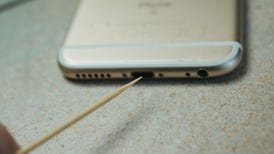
As Apple is expected to upgrade the design of its next iPhone, possibly trimming it down, there's been a lot of chatter about Apple finally moving away from its proprietary 30-pin connector, and going with a smaller connector. (The alleged iPhone spy photo above shows a smaller port at the bottom of the device).
A lot of people have been hoping for an industry-standard micro-USB connector, and, in fact, the European Union has already mandated that Apple provide for it. The only problem is that the EU regulations allow for Apple to offer a micro-USB adapter rather than alter the iPhone itself, thus neutering the regulation (Apple already offers the adapter).
Oh, and let's not forget that Apple charges a licensing fee for all of those Apple-certified speaker docks and various other accessories. We somehow doubt that Apple would let that nice income stream disappear, along with the ability to exert some degree of control over the design of those accessories.
So, we may get a smaller connector (and port), but we strongly doubt that it will be a standard micro-USB connector.
Chances of implementation: 5 per cent
-
(Credit: Visa)
NFC enabled
Leading up to the release of what turned out to be the iPhone 4S, rumour had it that Apple may have been working on integrating NFC technology into the next iPhone. This is sort of a barcode-replacement technology that would enable your iPhone to act as a payment device (e-wallet) or even a car key.
Since the feature isn't in the iPhone 4S, the odds increase that it'll make it into the iPhone 5. Also, the newly announced iOS 6 Passbook feature, which lets users store and quickly access electronic versions of all of their tickets, boarding passes and merchant cards in one place, may indicate that NFC will be added to the next iPhone.
Chances of implementation: 50 per cent
-
(Credit: iLounge.com)
More memory
People are happy that the iPhone 4S now comes in a 64GB version. But not everyone is satisfied. Some folks want a 128GB version.
Chances of implementation: 10 per cent
-
(Credit: Apple)
FaceTime (video chat) over 3G
Currently, on the iPhone 4 and 4S, FaceTime only works over Wi-Fi (yes, there are some ways to get it to work over 3G, but Apple doesn't officially support it). However, Apple announced that with the launch of iOS 6, FaceTime over a mobile data network will be enabled. Alas, Apple hasn't specified exactly which networks will support it. Will it be a 4G (LTE)-only affair, or will it work over HSPA+ and 3G networks?
Chances of implementation: 100 per cent
-
(Credit: CBSi)
Flash support
It'll be a cold day in hell when Apple allows Flash support on the iPhone. But that doesn't mean we can't continue asking for it.
Chances of implementation: 0 per cent
-
(Credit: Energizer)
Built-in inductive charging
Right now, if you want to charge your phone's battery using inductive "wireless" charging, you have to buy a separate charging sleeve (case) and charging mat for your device.
Companies like Powermat and Energizer make inductive charging products for a variety of smartphones. However, if you could do away with the sleeve and have the inductive-charging chip built in to the phone, you'd only have to buy a mat (and you could use whatever case you wanted to use).
Qi (pronounced chee), a new standard for inductive charging, as established by the Wireless Power Consortium (WPC), is pushing to get manufacturers to integrate Qi chips into their devices, and we should see some Qi-enabled smartphones on the market in 2012. The iPhone 5? We wouldn't bet on it, but at some point in the future we think the iPhone will get some sort of inductive-charging chip integrated into it.
Chances of implementation: 15 per cent
-
(Credit: Imagination Technologies)
Improved 3D graphics
Apple has consistently improved the iPhone's graphics capabilities with each new iteration, with the iPhone 4S offering a big jump over the iPhone 4 (Apple says it has a 7x performance boost).
The iPhone 4S has the PowerVR SGX543MP chip found in the iPad 2, and we expect that the iPhone 5 will get the next-generation PowerVR chip (the PowerVR SGX545 was also announced last year).
Chances of implementation: 85 per cent
-
(Credit: Apple/CBSi)
A6 processor
With Apple's acquisition of PA Semiconductor, it's been designing and churning out its own CPUs, including the 1GHz A5 processor in the iPhone 4S and the A5+ processor in the third-generation iPad.
Many people thought that we'd get the A6 processor with the new iPad — and that it would be a quad-core chip. But we didn't (the A5+ is a dual-core chip). The A6 chip is reportedly a 28-nanometer process, compared with the A5's 45nm, meaning lower energy consumption and higher speeds.
The faster processor would improve the performance of Siri, the iPhone 4S' integrated voice assistant, as well as a host of other features, such as still and video image capture.
Chances of implementation: 85 per cent
-
(Credit: CBSi)
4G network compatibility
One of the big features missing from the iPhone 4S is next-gen 4G data-network support. Apple finally delivered limited 4G support with the new iPad, pleasing US customers, but leaving the rest of the world in the cold.
Nevertheless, we fully expect the next iPhone to support some 4G LTE networks. Whether you'll be able to tap into every LTE network around the world is another story.
Chances of implementation: 100 per cent
-
(Screenshot by CBSi)
Better battery life
Every time Apple puts out a new iPhone, the battery life gets slightly better, so we expect no less from the sixth-generation iPhone. At least on paper, the iPhone 4S offers very similar battery life to the iPhone 4, so this is one area where there's significant room for improvement.
Chances of implementation: 50 per cent
-
(Credit: Cult of Mac)
New design
With the iPhone 4S, we didn't get the redesign that a lot of people were hoping for. Well, it's almost certain that we'll get it with the iPhone 5. Will it be thinner, with a teardrop design? Will it look more like the iPad 2? Will it have a bigger screen?
Maybe.
Chances of implementation: 99 per cent
-
(Credit: CBSi)
Larger screen
From our polling on CNET, our readers' number-one most-wanted feature is a larger screen.
That said, people don't seem to want the iPhone to get any bigger or lose any battery life. We're hoping that Apple can come up with the right balance, but, as you can see from this mock-up, going to 4 inches makes a significant difference, and is probably the optimal size for a smartphone screen.
Chances of implementation: 50 per cent
Via CNET


Add Your Comment 2